
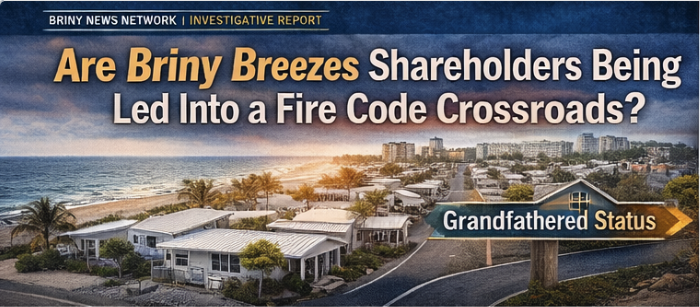
Are Briny Breezes Shareholders Being Led Into a Fire Code Crossroads?
A Briny News Network Investigation
By Briny News Network Investigative Desk
Briny Breezes, FL - For decades, Briny Breezes has existed as something rare in coastal Florida: a tightly knit, shareholder-owned community operating under long-standing grandfathered conditions related to fire code spacing, road width, and layout standards.
Today, that history is colliding with a new reality.
The Town has secured a Florida Resilient Grant for what is officially designated as major critical infrastructure redevelopment. The project centers on seawall reconstruction - infrastructure that officials have stated is necessary to protect the community’s assets from catastrophic storm risk.
But that designation - major infrastructure redevelopment - has triggered an urgent and unresolved question:
Can Briny Breezes undertake major infrastructure redevelopment without addressing modern fire code requirements?
Shareholders are now seeking a formal answer.
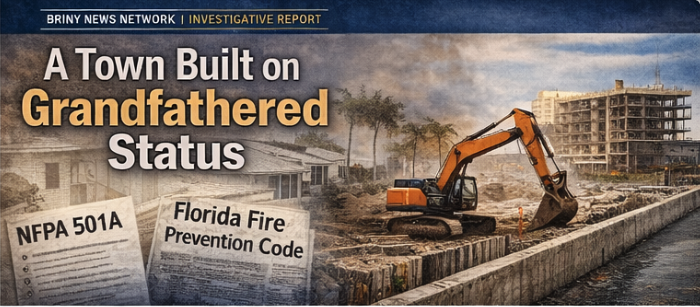
A Town Built on Grandfathered Status
Briny Breezes was developed long before modern fire separation standards became widespread. Homes are close together. Roads are narrow. Emergency access constraints have historically been acknowledged.
The community has relied on grandfathered provisions under the Florida Fire Prevention Code (FFPC), which incorporates:
NFPA 1 – Fire Code
NFPA 101 – Life Safety Code
Provisions such as NFPA 501A, governing manufactured housing communities
These standards generally allow existing communities to remain under prior code conditions - so long as they are not substantially altered.
That phrase is where the controversy begins.
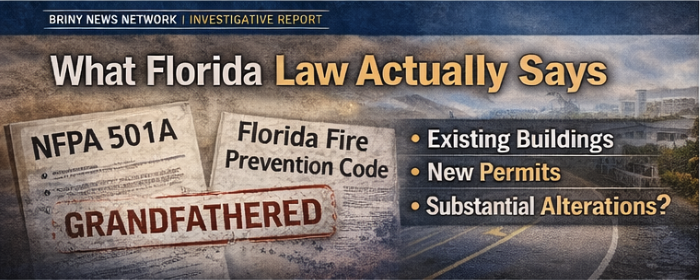
What Florida Law Actually Says
Under Florida Statute §633.208, the Florida Fire Prevention Code applies statewide. Subsection (4) states:
“The new-building or structure provisions of the Florida Fire Prevention Code shall apply only to buildings or structures for which the building permit is issued on or after the effective date of the current edition of the code.”
In plain language:
Existing buildings may continue under the code in effect at the time they were permitted.
New buildings must meet current code.
Substantial alterations or changes may trigger review under current standards.
The statute does not explicitly state that a “major infrastructure grant” automatically voids grandfathered status.
However, it also does not guarantee that grandfathering survives substantial redevelopment.
That determination rests with the Authority Having Jurisdiction (AHJ) — in this case, the fire marshal responsible for enforcement.
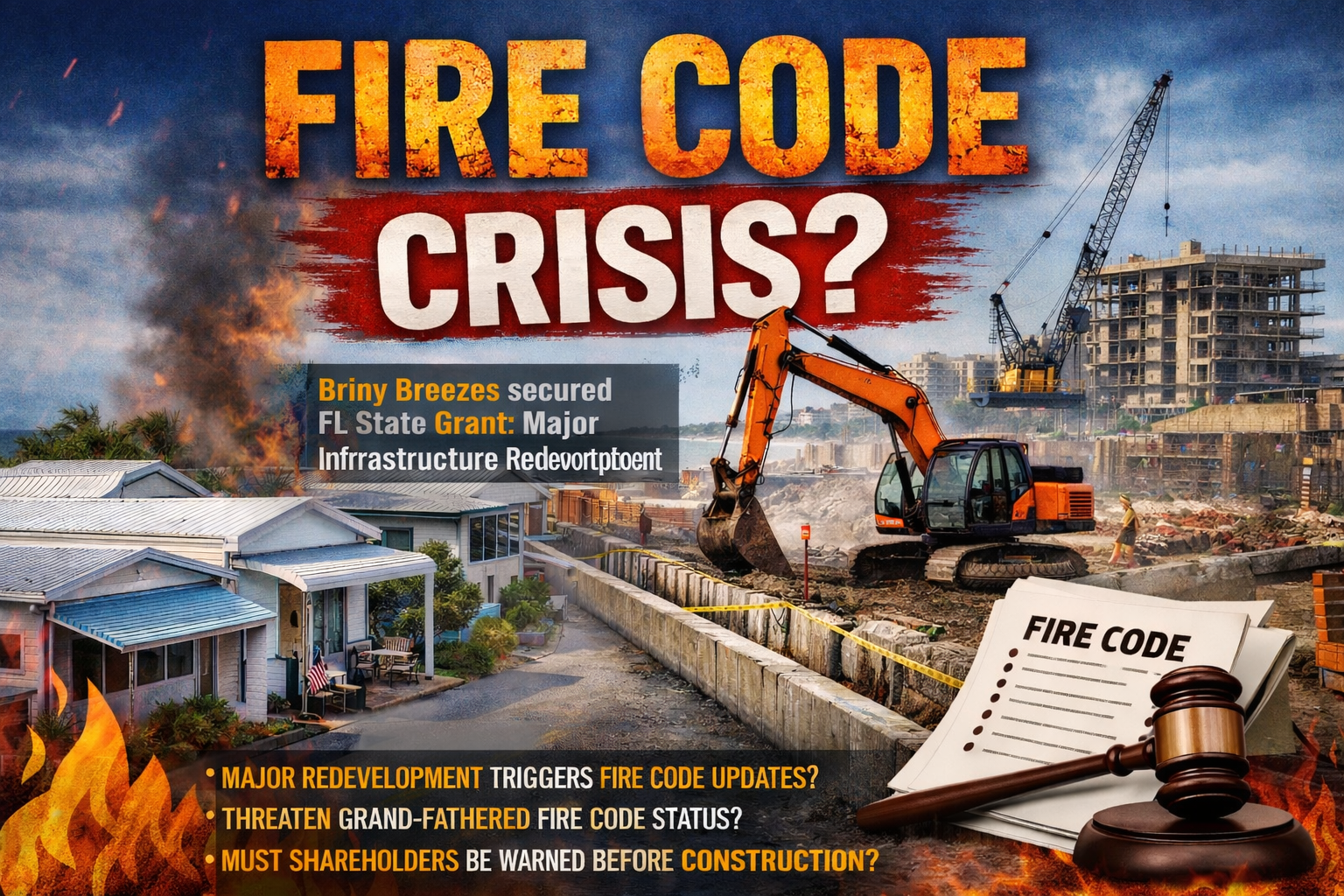
The Core Issue: What Counts as “Substantial”?
Here is the critical legal tension:
The Town applied for and received a grant categorized as major critical infrastructure redevelopment.
Shareholders are being told the seawall project does not constitute redevelopment that affects fire code status.
The fire marshal has indicated, informally, that seawall work alone does not automatically trigger loss of grandfathering.
But shareholders are asking:
If the State of Florida calls this “major infrastructure redevelopment,” how can it simultaneously be considered insignificant for fire code purposes?
That question has not yet received a formal written determination.
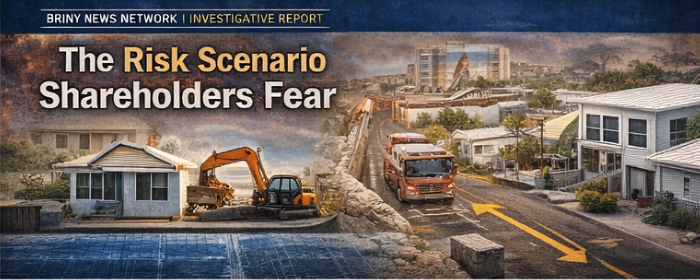
The Risk Scenario Shareholders Fear
The concern voiced by some residents is not theoretical.
If grandfathered status were lost, compliance with modern fire code could require:
Increased spacing between units
Road widening for emergency apparatus access
Potential loss of housing density
Significant structural alterations
Given the age of many residents and the fixed-income nature of the community, such requirements could have serious financial implications.
To be clear:
There is no current ruling that Briny Breezes has lost its grandfathered fire status.
But there is also no formal public determination confirming it remains intact in light of a state-designated major redevelopment project.
Transparency and Public Determination
Shareholders are now requesting:
A formal written determination from the Fire Marshal
Coordination between the Fire Marshal, Town Manager, and legal counsel
A public clarification of whether the project impacts fire code status
Because if the project does not affect grandfathering, that assurance should be made clear on the record.
And if it does — shareholders deserve to know before construction proceeds.
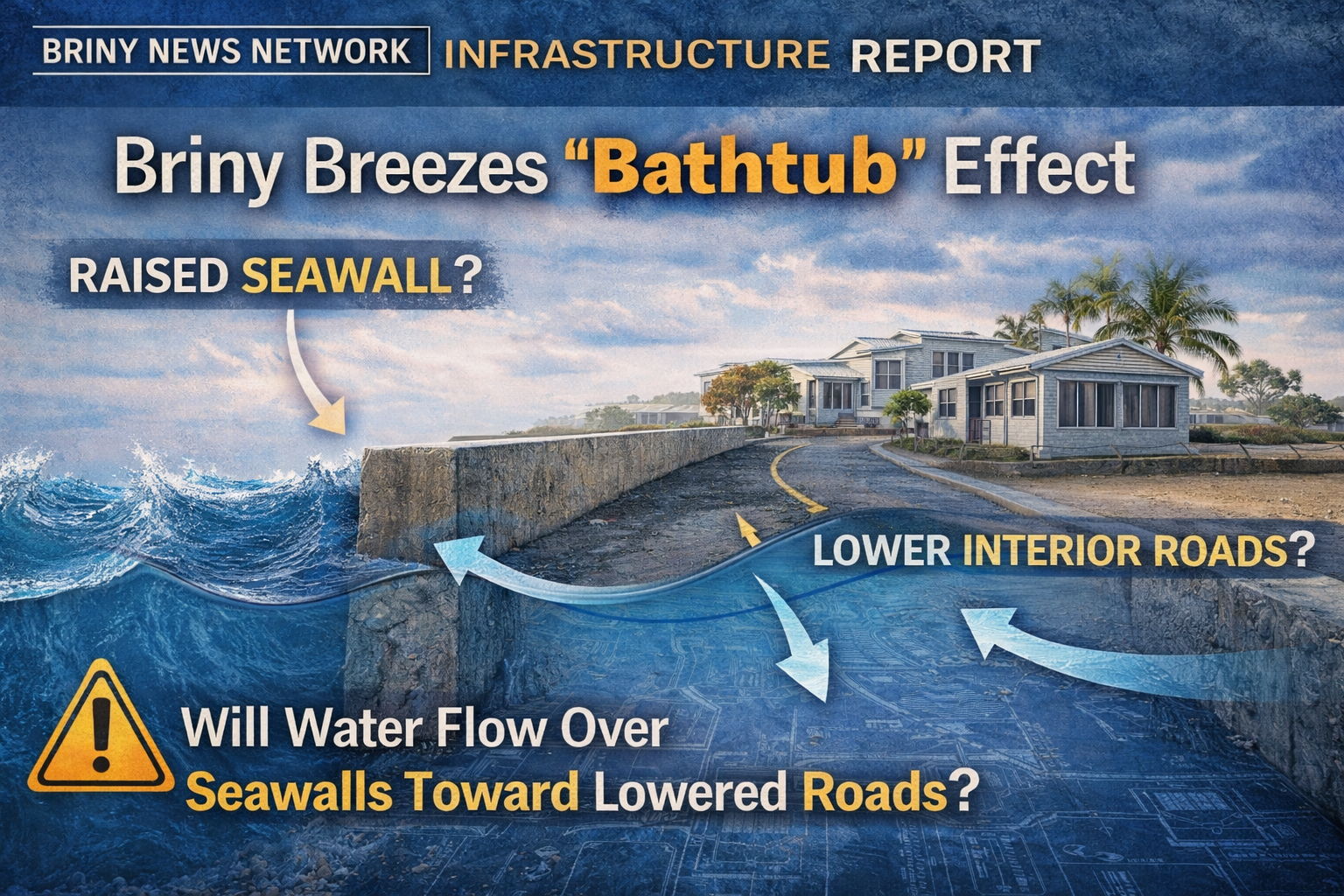
Infrastructure and the “Bathtub” Question
Separate from grandfathering, residents have also raised safety concerns regarding:
Raising seawalls without raising interior roads
Drainage implications
Emergency vehicle access during storm surge events
These are engineering and planning questions — but they intersect directly with life safety considerations.
If critical infrastructure is being re-engineered, some argue fire access and compliance must be part of that discussion.
Who Makes the Final Call?
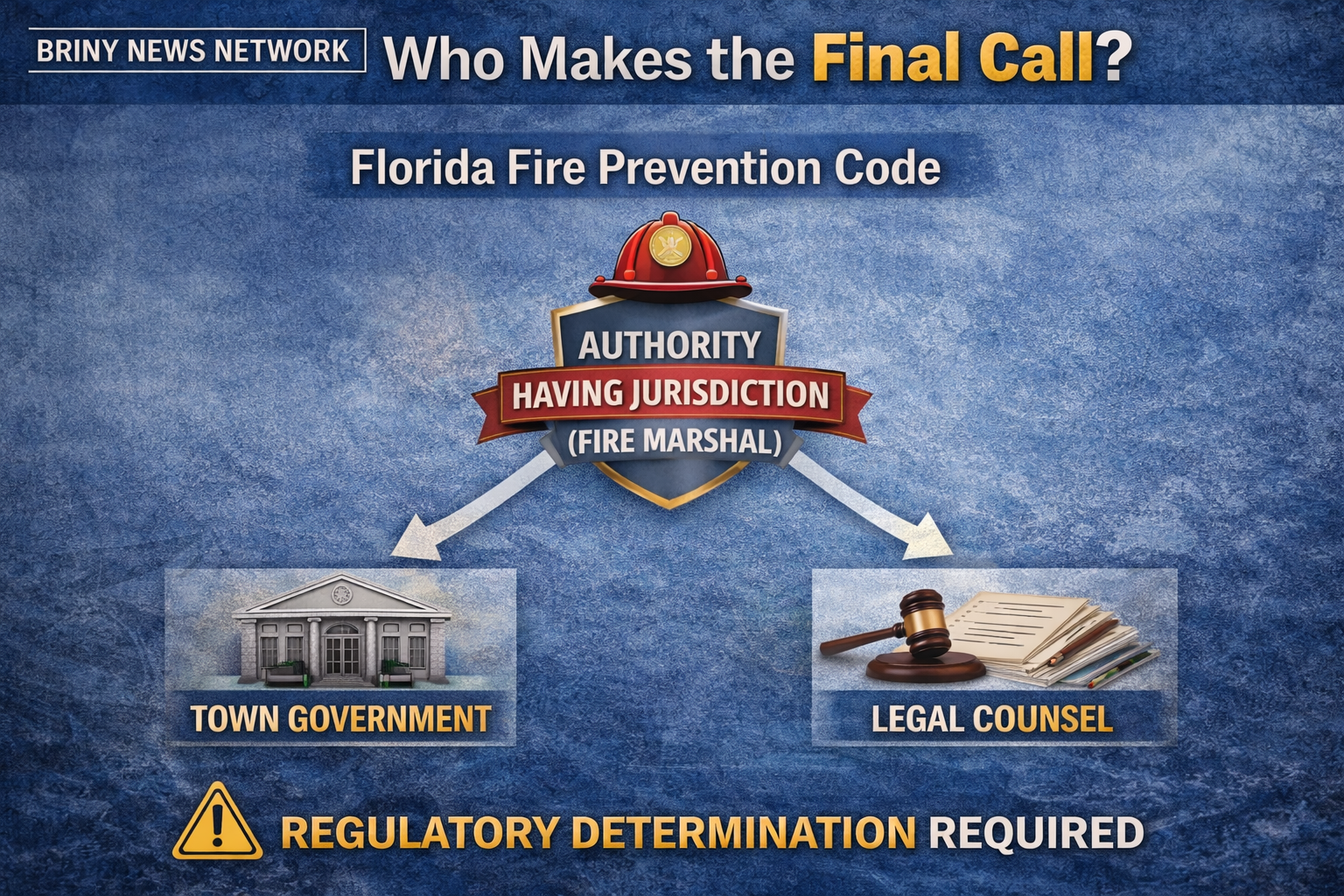
Legally, the decision rests with:
The Authority Having Jurisdiction (Fire Marshal)
The Florida Fire Prevention Code framework
Potential review by municipal or legal authorities if necessary
This is not a political question.
It is a regulatory one.
And it requires clarity.

Why This Matters
For many residents of Briny Breezes, their home is their primary asset.
The question is not whether seawalls are needed.
The question is whether a project classified as major infrastructure redevelopment can proceed without a definitive ruling on fire code implications.
Because once construction begins, reversing course becomes far more complicated.
The Bottom Line
At this moment:
No statute explicitly says “major infrastructure grant = automatic loss of grandfathering.”
No statute guarantees grandfathering survives substantial redevelopment.
No formal public determination has been issued resolving that tension.
That legal gray area is where the concern lives.
Briny News Network will continue to follow:
Any formal determinations issued
Public statements from fire officials
Legal interpretations affecting the community
Shareholder safety and property rights
